Catholic Classics Explained

Volume Two of Five

The Confessions of Saint Augustine


The first autobiography in the Western tradition, and not really an autobiography at all. Augustine wrote it around 397, already a bishop, roughly ten years after the conversion it describes.

Saint Augustine of Hippo, 354–430 · translated by Edward Bouverie Pusey · Oxford, Library of the Fathers
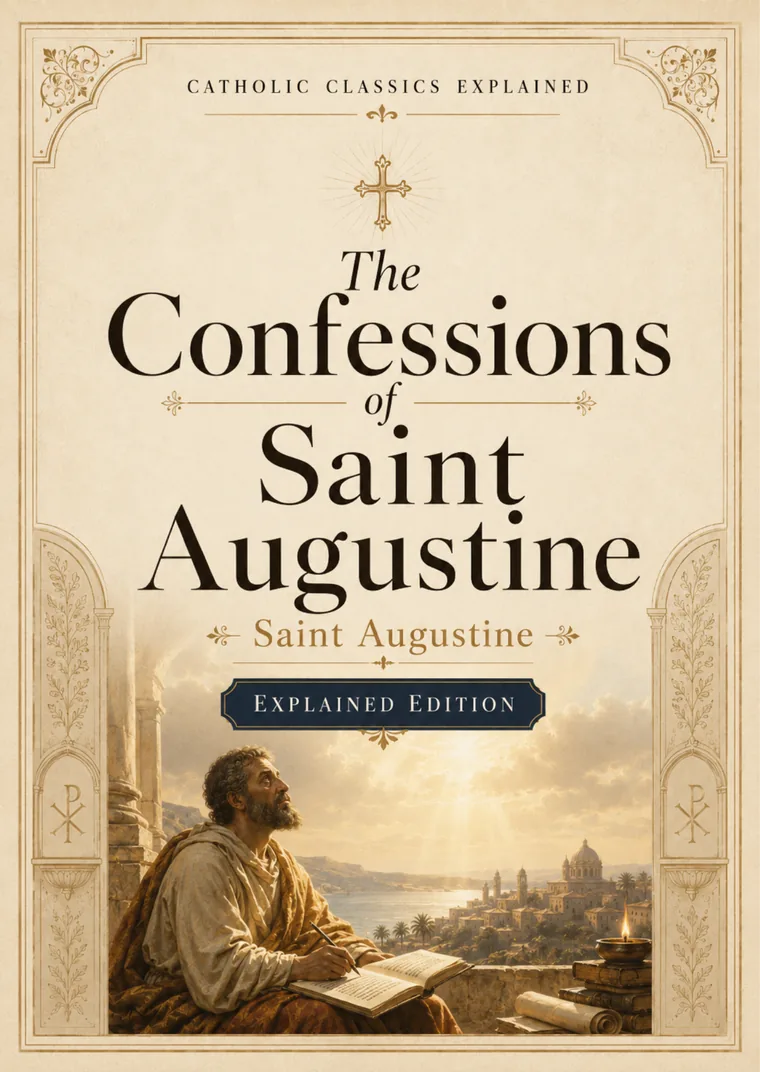
Cover of The Confessions of Saint Augustine, Explained Edition
276Chapters
111,800Words by the author
518Explanatory panels
661Typeset pages

Choose this volume when you want a life story that turns into an argument about memory, time and desire — and you are willing to follow it there.

What it asks of you: Patience through Book Ten, where the narrative stops.  ·  Difficulty: Demanding in the last four books

Where readers get stuck

The Confessions of Saint Augustine, and what it asks of you

Readers arrive expecting a life story and meet four registers alternating without warning: memory, prayer, philosophy and biblical exegesis. Most give up in Book Ten, where the narrative stops and an examination of memory begins.

What this edition adds

  • The form named at the outset: the whole work is addressed to God in the second person. It is prayer that readers overhear, which is why it feels so unaccountably intimate.
  • The intellectual world it assumes — Manichean dualism, Academic scepticism, the books of the Platonists, the career of rhetoric, the deferred baptism — explained where the text needs it.
  • The dense passages given room: the divided will of Book Eight, the nature of evil in Book Seven, memory in Book Ten, time in Book Eleven.
  • Where Augustine writes in 397, before the controversies that fixed later terms, the difference from settled doctrine is stated plainly and without polemic.

The shape of the work

Thirteen books · 276 chapters

Books I–IV

56 chapters

Infancy and school, the pears, Carthage and the Manichees, the death of the friend.

Books V–IX

76 chapters

Faustus, Rome, Milan, Ambrose, the Platonists, the garden, baptism, Ostia.

Book X

43 chapters

The turn from the past to the present. What memory is, and the examination of the self before God.

Books XI–XIII

101 chapters

Time, formless matter, and the days of creation read spiritually.
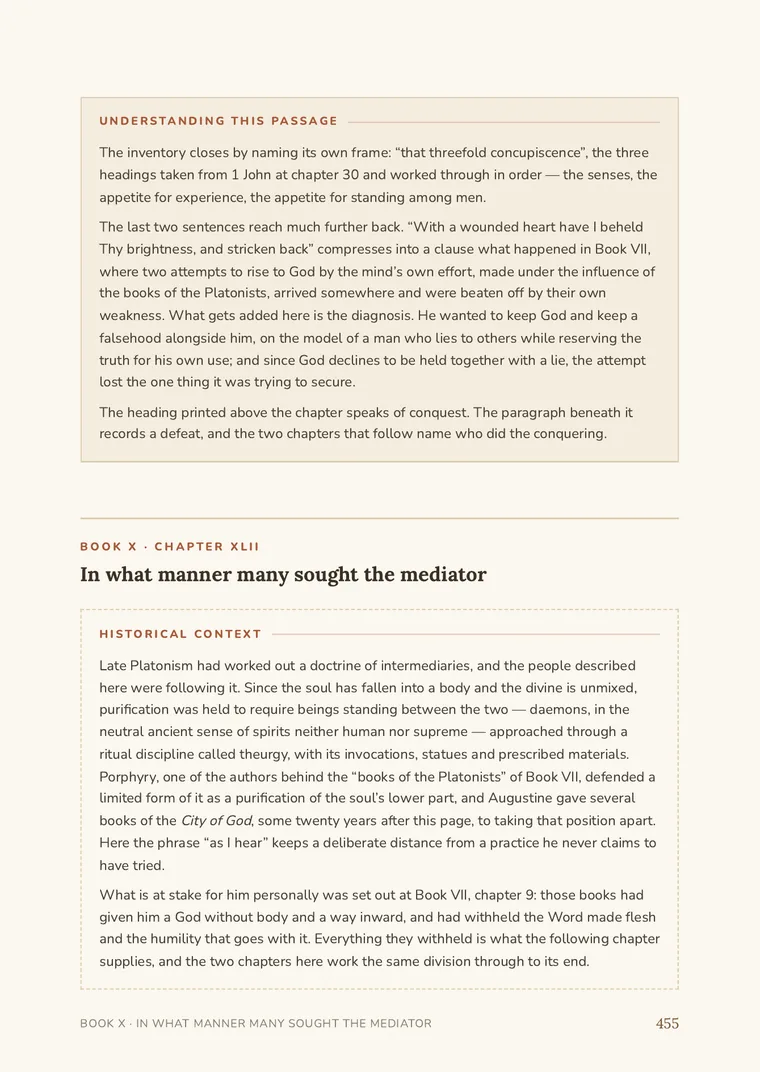
A page of the Confessions: Augustine in Pusey’s English, with a panel identifying the Scripture behind the wording and the Vulgate psalm numbers

The whole work, with a guide at your side

All 276 chapters, unabridged, in 661 typeset pages. Read it straight through or study it a chapter at a time.

Volume Two of Five

The Confessions of Saint Augustine

Saint Augustine of Hippo · Thirteen books · 276 chapters

$27USD

One payment. Yours to keep.

  • The complete work in the Edward Bouverie Pusey translation — all 276 chapters, nothing abridged, nothing rewritten.
  • 518 explanatory panels, placed only where the text is genuinely difficult. Whole chapters go by without one.
  • Opening apparatus: a note on the edition, a guide to reading it, an introduction to the author and the work, and a map of the argument.
  • Summaries and study questions at the close of every part, each question pointing back to a named chapter.
  • A glossary defining terms in the sense the author gives them, not the dictionary’s.
  • A thematic index whose every reference was opened and checked before it was printed.
  • 661 typeset pages at 170 × 240 mm, with clickable contents and internal links.
Get this volume — $27
PDF for screen and print Instant download 30-day guarantee

The historical translation is in the public domain. What you are paying for is the edition built around it: the explanations, the apparatus and the typesetting.

Reading more than one? The complete collection of five volumes is $97 — a saving of $38.